


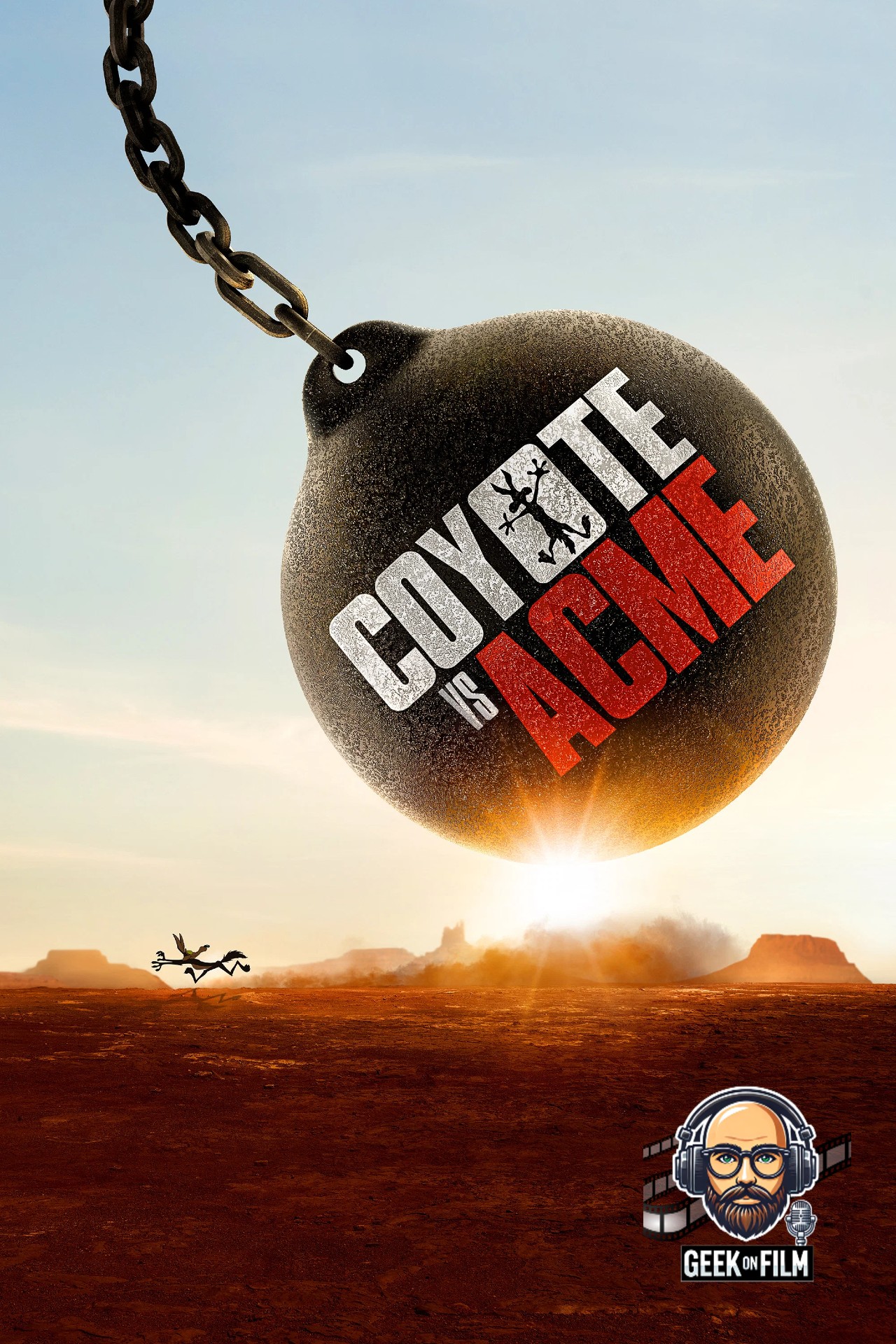
Coyote vs. Acme
Review Date:
Synopsis: After years of Acme products failing him in his endless pursuit of the Road Runner, Wile E. Coyote hires down-and-out lawyer Kevin Avery (Will Forte) to sue the Acme Corporation for product liability, squaring off against Acme's slick defense attorney Buddy (John Cena) in a legal battle that puts the whole Looney Tunes universe on trial.
Review:
I went into Coyote vs. Acme rooting for the little movie that could — the one Warner Bros. finished, tested well, and then buried anyway, opting for a $30 million tax write-off over releasing a film that cost $70 million to make. What I didn't expect was to sit in a packed theater surrounded by both adults and kids who were getting it. This movie deserved its shot, and eventually, because Ketchup Entertainment bought it, it got one — despite how its original studio treated it.
The short version: this movie lived up to everything I hoped it would be. It firmly establishes the Looney Tunes characters as living, breathing residents of the real world, not guests visiting it — and on its own, that's a solid, well-made comedy. I'll admit I probably have too much nostalgia for these characters to be fully objective about it, and that's what bumps it up the extra half star.
A World Where They've Always Belonged
What struck me most is how seamless the integration is. This isn't a movie about cartoon characters crashing into our world — it's a movie set in a world where Looney Tunes characters have simply always existed, and the human characters treat them exactly that way. Nobody in this story stops to marvel at a talking coyote hiring a lawyer. That acceptance is what gives the film its strange, specific texture — a kind of surreal realism, where the absurd and the mundane sit right next to each other without either one blinking.
The Casting Is No Accident
The casting is a masterstroke, and it's because neither lead had to bend to fit this world. Will Forte plays Kevin Avery exactly the way he plays every great Forte character — silly, downtrodden, a little worn down by life, not far removed from his work on The Last Man on Earth. He didn't need to be recalibrated for a Looney Tunes movie; he already fits. John Cena is the inverse case and just as perfect: the man is basically a human cartoon character already, built by a career in professional wrestling that trades in exaggeration and spectacle. Casting him as Acme's courtroom nemesis isn't a stunt — it's the most logical casting decision in the film.
Silence as the Whole Performance
The most impressive creative choice in the whole film is one of restraint: this is the silent-film-era Wile E. Coyote, not the talking "Super Genius" version. There's no dialogue to lean on — just a character who has to carry an entire movie's worth of emotion in a world full of people who speak, using nothing but his face and his physicality. It works, and it works because the performance behind it is doing serious work. I've heard it described as full Meisner technique from Wile E., while the Road Runner stands opposite him like a stoic sculpture. That contrast is the whole joke and the whole heart of the film at once.
Neither character could exist without the other, even if only one of them knows it. Wile E. wakes up every day with nothing on his mind but catching the Road Runner. The Road Runner wakes up every day and doesn't think about Wile E. at all — he's not a threat worth acknowledging, just something to be outrun without effort. It's the same one-sided dynamic that makes Batman and the Joker work: one side is consumed by the other, and the relationship only really belongs to him. And then the film ends with a sign that undoes all of that: the Road Runner, alone, holding up a card that reads "When are you coming back?" For all his indifference, he needs Wile E. to be his nemesis. It's a small moment, and it's sweeter and more emotional than I expected a Looney Tunes gag to land.
Roger Rabbit, Without the Border
The natural comparison here is Who Framed Roger Rabbit, since both movies are built on the same basic premise: humans and cartoons sharing a world, and both commit fully enough that the interactions feel real rather than gimmicky. In both films, the humans who interact with the cartoon characters don't treat them as anything unusual — they're just there, real, part of the world. But the two films take genuinely different approaches to that world. Roger Rabbit creates a border — Toontown exists as its own place, connected to human society but distinct from it, something you cross into. Coyote vs. Acme removes the border entirely. The Looney Tunes characters aren't visiting from somewhere else; they're fully integrated into human society, with no line between the two. There's also a strange, almost circular bit of shared DNA between the two films: cartoons can take a beating that would kill a human and just walk away from it. That rule effectively originated with the classic Looney Tunes shorts, Roger Rabbit borrowed it and put it on full display, and now a modern Looney Tunes movie is drawing on a convention that Looney Tunes itself invented. It's a small paradox, but a satisfying one.
Who Should See It
I saw this at a Cinemark in Mesa, and the theater was fuller than I expected for a movie with this kind of release history — a real mix of adult groups and families, not just a kids'-movie crowd. And that mix tracked with how the film actually plays. Anyone who grew up on these characters is going to get everything out of this movie, full stop. For kids, it's a little more complicated: the plot itself is instantly legible even to someone who's never seen a Looney Tunes short — Wile E. wants to catch the Road Runner, he never does, everyone gets that immediately — but a lot of the actual humor is built around a courtroom case, complete with depositions and sight gags delivered on handwritten signs. That's going to land better for kids around eight or ten and up than for younger ones, even if the premise itself never confuses anyone.
I went to see this because I wanted to support the little movie that could — the one a studio finished, tested well, and decided wasn't worth releasing. But that's not why you should see it. You should see it because it's actually a really good movie, full stop, and the underdog story is a bonus on top of that, not the reason for it. The moment that's stuck with me most happens on a phone call late in the film — a whispered, anonymous tip, shot like something out of Watergate, all Deep Throat shadows and secrecy. It opens with four words: "What's up, doc?" Kevin Avery says out loud that he doesn't recognize the voice. But from the back of my theater, a kid shouted out, "That's Bugs Bunny!" It worked on every level it needed to — as a mystery, as a joke, as a piece of craft — but that one just made me happy.
 Never miss a story from us, subscribe to our newsletter