


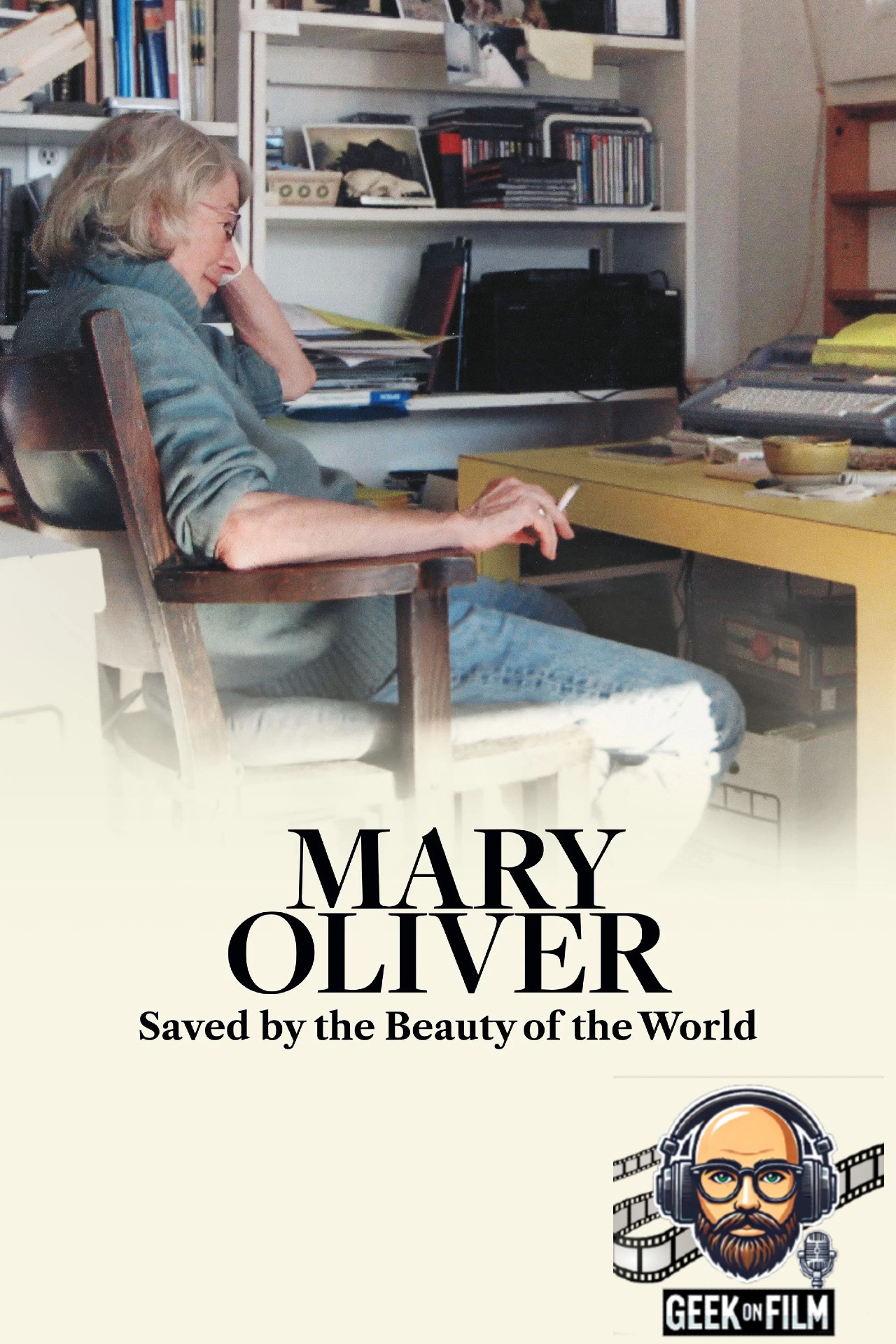
Mary Oliver: Saved by the Beauty of the World
Review Date:
Synopsis: If poetry had a pop icon, Mary Oliver would be it. Celebrated best-selling poet, Pulitzer Prize-winner, lover of dogs and long walks in the woods, openly queer but intensely private, Oliver was America's unlikely contemporary mystic. Featuring interviews with her close friends, including John Waters, and recitations of her work by Stephen Colbert, Lucy Dacus, Steve Buscemi, Helena Bonham Carter, and Oprah Winfrey.
Review:
Too Long Don’t Read TL&DR
A documentary that refuses to settle into a single mode and is better for it. Sasha Waters Freyer moves fluidly between Talking Heads confessionals, archival materials, and intimate recitations — and what emerges is less a biography than a film about what happens to people when great art finds them. I came in knowing of Mary Oliver. I left with a deep feeling of care for her, her work, and the remarkable range of people who loved her for it.
Mary Oliver wasn’t on my radar.
Not because she didn’t deserve to be — as this film makes abundantly clear, she deserved every bit of it and then some. A friend extended an open invite to a Phoenix Film Society screening at Harkins Scottsdale 101, and I decided to take it. What I walked out with was a deep respect for her work, her life, and the profound effect she had on the people lucky enough to find her.
The film opens with Stephen Colbert trying to recite The Summer Day — perhaps Oliver’s most beloved poem — to the camera. He warns us upfront that he may not make it through. He doesn’t. That moment sets everything up — this isn’t a clinical biography of a literary figure. It’s a film about what her words actually do to people.
The Form Fits the Subject
Mary Oliver gave almost nothing of her interior life away — not in interviews, not in public appearances, not until much later in her life when she became somewhat more open. What that means for a documentarian is that the traditional biographical toolkit is largely unavailable. There is no treasure trove of confessional footage, no intimate home movies, only glimpses of a childhood captured the way childhoods were captured then — sparse, accidental, not designed for posterity.
Freyer turns that constraint into the film’s defining strength. Because Oliver couldn’t be known directly, the film assembles her the way her readers always have — obliquely, through what she left behind. Nature footage stands in for interiority. Poetry recited by others becomes testimony. Archival photographs and notebooks offer texture without explanation. That access to the notebooks and personal materials was made possible in part by Lindsay Whalen, who is writing the first biography of Oliver for Penguin Press and served as a consultant on the film — giving Freyer a window into the archive before it was delivered to the Library of Congress. Whalen appears on camera as well, providing the kind of scholarly grounding that keeps the film honest without ever making it feel academic. The Talking Heads confessionals from people she touched tell us who she was by telling us what she did to them. The form isn’t just variety for variety’s sake — it mirrors exactly how Oliver wanted to be known: through the work, through the natural world, through the effect she had on others rather than anything she said about herself.
It shouldn’t work as cleanly as it does. But it does.
The Film
The range of voices Freyer assembles is part of the argument. John Waters, Steve Buscemi, Helena Bonham Carter, Lucy Dacus, and Oprah Winfrey — on paper that’s a lineup that shouldn’t cohere. On screen it makes perfect sense, because Oliver’s reach never respected the categories we use to sort people. Bonham Carter’s reading of I Worried lands and is gone — a quick drop in, a poem delivered, a drop out — and somehow that restraint makes it hit harder. That’s the throughline of the entire film — Freyer never oversells, never editorializes, never tries to convince you of Oliver’s greatness. She simply creates the conditions for you to feel it yourself, and then lets the poems take over from there.
Mary Oliver didn’t project her inner world outward — that was simply who she was, and Molly Malone Cook became its protector. The footage of Cook tells you everything: that short bob haircut, dark sunglasses, cigarette in hand, a woman with a beatnik energy who clearly understood that some worlds are worth keeping private. After Oliver won the Pulitzer, Cook became even more protective of that world — keeping the outside at arm’s length so Mary could keep walking into the woods and paying attention to what actually mattered. There are clips of the two of them together, moments that feel almost stolen, and the film is wise enough to let them breathe without over-explaining them. Freyer roots their love story in Steepletop — the Edna St. Vincent Millay estate in upstate New York where a seventeen-year-old Oliver fled the day after high school graduation, and where she would eventually meet Cook in 1959. That place is the hinge of her entire life: where poetry became her escape, and where her great love began.
What It Left Me With
I’ll be honest: I came in knowing of Mary Oliver more than I knew her work. What I left with was something I didn’t expect — a deep feeling of care for Mary herself, for the work she devoted her life to, and for the remarkable range of people who loved her for it. Walking out of that theater my first thought was that I couldn’t wait to tell my wife Amy about it. She hears about a lot of films through my eyes and my experience — this is one I want her to actually see.
A Note on How I Got There
I moved to Phoenix in August 2025, and the Phoenix Film Society has been on my radar since essentially the day I arrived. I’ve been attending their public screenings — my 25 Cats From Qatar review came out of one of them — but this particular screening was different. I was invited as a guest of a member, which meant getting a closer look at what this community actually is when it’s fully assembled.
Phoenix has a real film community — more than people give it credit for. I’ve found my way into a few corners of it already. But the Phoenix Film Society sits at the center of it in a way that’s hard to ignore. I’ve been waiting for my world to settle before committing as a member, but nights like this make it hard to keep waiting. The Middleberg Film Festival was where I started building roots in Virginia. The Phoenix Film Society is where I intend to build them here.
If you’re in the Phoenix area and you love film — look them up. And if you see me at a screening, say hi.
The moment in the film that moved me most was Oliver speaking about Molly after her death in 2005. What the film used was simple and abridged — “We were talkers. It was a forty-year conversation.” This statement rocked me. Anyone who knows me knows that talking is what I do — it is effectively my love language, to expose and share what I am feeling to others I care about. I went looking for the full passage afterward and found it in Our World, Oliver’s tribute to Cook: “We were talkers — about our work, our pasts, our friends, our ideas ordinary and far-fetched. We would often wake before there was light in the sky and make coffee and let our minds rattle our tongues. We would end in exhaustion and elation. Not many nights or early mornings later, we would do the same. It was a forty-year conversation.”
Because what is love in a relationship, if not a conversation with your best friend that you never want to end?
 Never miss a story from us, subscribe to our newsletter