


Backrooms (film and series)
Review Date:
Synopsis: After a therapist's patient disappears into a dimension beyond reality, she must venture into the unknown to save him.
Review:
Too Long Don’t Read TL&DR
Backrooms is a psychological terror vehicle with a story bolted onto it. Directed by Kane Parsons at 19 years old and released at 20, it became the largest opening weekend in A24 history not because it explained everything, but because it made you feel something you couldn’t explain. The quiet is the horror. And then it sends you looking for more — which is exactly what it was designed to do.
I am not a native of the internet ecosystem that created the Backrooms.
I was not on 4chan in 2019 when an anonymous user posted a single photograph — a dim, yellow-carpeted room with no windows and no exits — in a thread asking people to share images that felt “off.” I did not follow the community of creators who took that image and began building a world around it, establishing shared rules, contributing lore, documenting variations. I came to this mythology through a theater seat and an A24 logo, which is about as late as you can arrive.
And then I couldn’t stop. My wife will confirm this. The moment I walked out of that theater I was infected — by the dread, by the opacity, by the specific thirst it creates in you to know more. What I didn’t understand yet is that the thirst is unquenchable by design. The Backrooms doesn’t offer relief. It offers more rooms. She is still tired of hearing about it. I regret nothing.
What happened between seeing the film and writing this post is that I spent a week watching Kane Parsons’ entire YouTube series — all 24 episodes, in order — on his channel Kane Pixels. I came out the other side with more detail about the world than I could have imagined going in, and not a single additional answer.
Everything I knew about the Backrooms when I started that series came from two hours in a theater. That is where we need to begin.
The Film
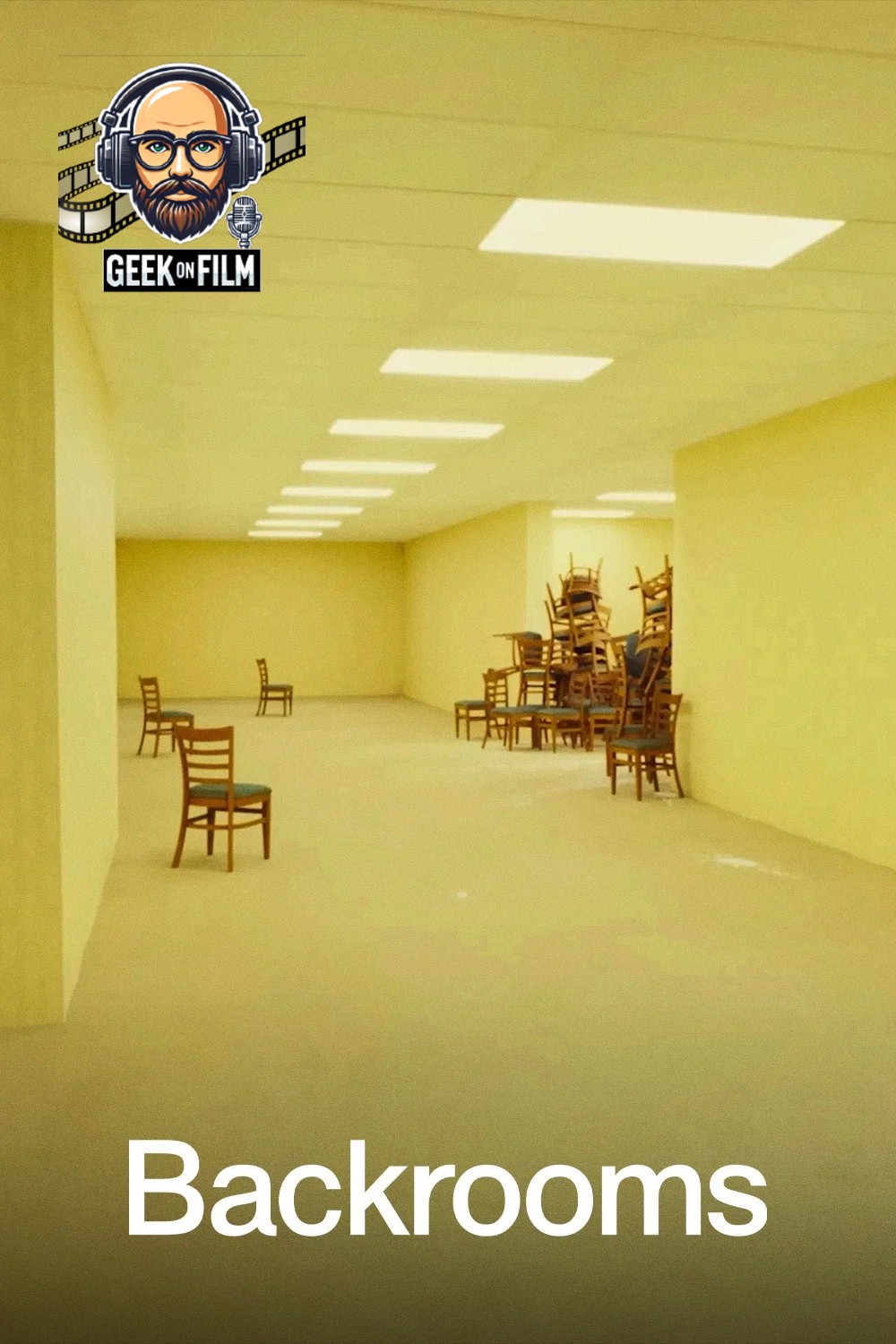
Backrooms is a psychological terror vehicle with a story bolted onto it. Written by Will Sodick and Kane Parsons, directed by Parsons at 19 years old and released at 20, it became the largest opening weekend in A24 history not because it explained everything, but because it made you feel something you couldn’t explain. There are horrific moments and genuine jump scares, but the real horror is the psychological crush of it — the endless yellow of every surface, that specific wallpaper with its pattern that feels perpetually off, and the fluorescent hum that never stops. The wallpaper becomes your baseline for normal inside this world, which means the moment it shifts or angles wrong you feel it before you can name it.
The premise is deceptively simple. Clark — played by Chiwetel Ejiofor — is a failed architect turned furniture store owner in the 1990s, a man drowning quietly in the debris of a life built around things that don’t hold. His store is called Cap’n Clark’s Ottoman Empire, and in the opening commercial he is dressed as a pirate, sitting on a throne, making puns. The person filming asks him whether he’s a pirate or a sultan — the name says ottoman empire, the costume says something else entirely — and Clark has no good answer. At the end of the shot the throne cracks and collapses under him. Cheap particle board. A man trained to design real spaces, now selling fake ones, and even those won’t hold him. That need to master a space — to understand it, map it, control it — is exactly what draws Clark deeper into the Backrooms. And exactly what destroys him.
One night, drunk and sleepless in the store, following flickering lights down to the basement, Clark walks through a wall. Not dramatically. Not with fanfare. In the language of the Backrooms community it’s called no-clipping — the idea borrowed from old video games where a failure in the geometry lets you pass through a solid surface into the space behind it, somewhere the map wasn’t supposed to show you. Clark doesn’t fall through a portal or step through a door. He just walks through a wall, the way the world occasionally forgets to be solid. Eventually he marks the spot with a strip of blue painter’s tape — a small, human gesture of control over something that cannot be controlled. It is a detail that recurs across the Kane Pixels series too, people marking thresholds as if tape could hold the boundary between worlds.
What’s on the other side is not the world Clark is so sad about — the failed architect reduced to selling cheap furniture, the divorced man sleeping in his own showroom, the therapy sessions where he has to account for all of it. What’s on the other side is the Backrooms: endless yellow wallpaper, fluorescent lights that hum constantly, corridors that stretch into nothing. But also rooms that shouldn’t exist — entire spaces filled with pools, stop signs with the words reversed, a seagull that has no business being there. A world that almost makes sense and then doesn’t, that feels like a place you’ve been but can’t quite name. Liminal. Wrong. Infinite. And for Clark, perversely, a relief.
His therapist Mary, played by Renate Reinsve, eventually follows him in. She is her own kind of trapped — raised by an agoraphobic mother who turned their home into a fortress, now building a career out of helping people escape the spaces that hold them. We see her hosting a party, perfectly cast in the role of composed and charming hostess, and then we follow her behind a closed door where she quickly takes what appear to be prescription pills before returning to her guests. Later we see her late at night, unable to sleep, watching infomercials for her own self-help books on tape. She is selling the methodology of getting unstuck to the world while quietly drowning in the same water as her patients. The film doesn’t overplay the parallel. It doesn’t need to.
Where this film outpaced the script is in what Parsons does with the space itself. The cinematography gives you a first-person shooter feel — sometimes through VHS camcorder footage, that scratchy low-resolution 4x3 window that feels both period accurate to 1990 and deeply wrong, sometimes simply through directorial choice. You are in the space. You are moving through it. Every time the camera swings you are checking the corners, scanning the edges of the frame for something that shouldn’t be there. The fluorescent hum is constant. The yellow wallpaper and textured yellow carpet create a visual baseline so consistent that any deviation registers immediately as threat — a wall angled slightly off, a room that shouldn’t connect to the next one, a real world object embedded halfway into a floor or a wall as if the space swallowed it and then stopped. Your eyes are doing threat assessment the entire time you are watching.
And then there are the footsteps. Somewhere you can’t see. Something you can’t source. The broader Backrooms community has a rule that has circulated long enough to feel like law: if you can hear footsteps, whatever is making them already knows you are there. It is already too late. Parsons never states that rule in the film. He doesn’t need to. The dread of the unseen, the thing that hasn’t appeared yet but is clearly, undeniably, coming — he builds it from the hum and the wallpaper and the breathing alone. The film opens with a VHS sequence so disorienting and off-putting that it calibrates you for everything that follows. As Clark explores the space you explore it with him — you learn its rhythms, you absorb its rules, you think you know what awaits anyone who enters. When Mary walks through that door the audience is confident they know exactly what she is about to experience. We could not have been more wrong.
I don’t think this is a traditional horror movie. It is closer to a dread-creation machine that happens to have characters and a story running through it. Some people will be frustrated by its opacity. Some will want more explanation, others will feel there is already too much. That is the point. This film is a Rorschach test — and it works on you whether you want it to or not. It worked on me. Four stars and a heart. Within 24 hours of leaving the theater I was on Kane’s YouTube channel looking for answers.
The Series
The Kane Pixels series begins on January 7, 2022, with a short found-footage film: a camera operator finds himself inside the Backrooms, explores the endless yellow corridors, and encounters something that should not be there. It was made by a 16-year-old using Blender and After Effects, with a VHS filter to soften the CGI. It has over 79 million views.
What follows across 24 episodes is something I could not stop watching — an analog horror series built around a fictional organization called the Async Research Institute, a private research firm based in San José, California that has been quietly, catastrophically opening holes between our world and the Backrooms since the late 1980s. Their stated goal: to solve overpopulation and housing shortages by accessing a theoretically infinite storage dimension. Their actual achievement: something far worse and far stranger, documented across decades of institutional cover-up, lost researchers, and surveillance footage that captures things no one at Async can fully explain. In the film, Mark Duplass plays Phil, an Async scientist who gets to deliver the most unsettling piece of corporate understatement in the movie — that Async started out as an MRI company and simply found the Backrooms along the way, as if stumbling into an infinite dimension of dread was a minor pivot in their business plan.
Parsons constructs the mythology with the patience and internal logic of someone who genuinely loves worldbuilding. The timeline is non-linear — episodes jump between 1989 and 1996 and points in between, and the most important events are often revealed only in the background of other events, glimpsed in archival footage or buried in a corporate memo. There are hidden episodes, unlisted on YouTube, accessible only through links in the descriptions of the main videos — I have barely scratched the surface of those and I am already looking forward to going deeper. The series rewards obsessive attention in the way that the best serial storytelling always has — except that here the obsession feels thematically appropriate. You are doing to the Kane Pixels universe exactly what the Async researchers are doing to the Backrooms: cataloguing endlessly, finding new rooms, never quite reaching the center.
I watched all of it in order. It took most of the week. I came out the other side with more interest in the story than I went in with, and not one additional answer.
Here is what I kept noticing: the series gives you more and more of the world — more ASYNC documents, more recovered footage, more institutional history, more glimpsed corners of the mythology — and yet the center never gets any closer. You are constantly on edge, peering into every corner of every frame, alert to every background detail, convinced that this time something will resolve. And over ninety percent of the time, nothing does. The humming yellow corridors stretch on. The Lifeform moves somewhere just out of sight. Another ASYNC memo surfaces, adds texture, raises three new questions, answers none of the old ones.
What I realized is that this is not a gap in the storytelling. It is the storytelling. Parsons has built a series that formally replicates the experience of being inside the Backrooms. You catalog, you map, you accumulate evidence — and the space simply continues, indifferent to your need for resolution. The dread is not just in what you see. It is in the act of looking, episode after episode, finding just enough to keep going and never enough to stop. The explained monster is never as terrifying as the unexplained one, and Parsons never explains the monster. Every answer opens three more rooms. I finished all 24 episodes and now I want to find every hidden video, every easter egg, every breadcrumb buried in this world. I have a feeling I will be looking for a while.
What the Series Gave Back to the Film
Parsons made a deliberate choice with the A24 film: it is not a direct adaptation of the YouTube series. It is a standalone story set in the same mythology, with its own characters and emotional architecture, fully accessible to someone who has never seen a single episode. There are people for whom this film will only frustrate — the opacity, the ambiguity, the questions it refuses to answer will feel like a cheat. I understand that response. But then there are the people like me, who walked out of that theater not frustrated but infected, not empty but full of questions, and couldn’t leave the world alone. This film knows exactly who it is making itself for.
Having now watched all 24 episodes, the film has a resonance it couldn’t have had for me sitting in that theater. Clark walking through that wall in 1990 is not just a man stumbling through a seam in reality — he is stumbling into a space that Async has been destabilizing for years, one no-clip accident among many, the consequence of a corporate experiment in solving housing crises that quietly tore open the fabric of the world. The institutional horror underneath the personal horror becomes visible. The yellow wallpaper isn’t just wrong — it’s a place with a history, even if that history is only partially known and may never be fully understood. The film didn’t need me to know any of that. It holds without it. But the series makes it richer, the way knowing a building’s history changes how you experience its rooms.
This film can be a standalone experience, and for most people walking into a theater it will be. But it is also built as an entry point, designed to send curious people looking, knowing that what they find will loop them back to the theater with new eyes. The harder question is whether it gave the people who were already there — the YouTube faithful, the Reddit lore-hunters, the community that spent years building and documenting this world — what they came for. I’m not sure it did, at least not entirely. The film is deliberately restrained about the mythology, more interested in the emotional experience of the space than in rewarding deep knowledge of the canon. Whether that feels like wisdom or a missed opportunity probably depends on how many hours you have spent in the Kane Pixels rabbit hole before you bought your ticket.
I walked out wanting more. The series gave me everything except answers. Now I want even more — and I mean that not as a complaint but as the most honest description of what it feels like to be inside a mythology that is genuinely alive.
The Bigger Picture
What is happening with the Backrooms is something I don’t think we have a clean category for yet. It started as a single anonymous image. It became a community-built mythology — open-source folklore, in the truest sense, with shared rules and documented variations and hundreds of contributors who loved the world too much to leave it alone. Then a 16-year-old filmmaker with genuine vision took that community’s work and gave it a spine, a timeline, an institutional logic. That same person, at 19, was handed a budget and a cast and a 30,000 square foot set and directed the whole thing himself. At 20 the film became A24’s biggest opening weekend ever.
That is not a pipeline. That is a convergence. And it feels to me like a specific kind of thing that is starting to happen more — a generation of self-taught creators who grew up making things on the internet, getting feedback in public, developing real cinematic instincts entirely outside the traditional system. Parsons is not an anomaly. He is an early signal of a creative generation that learned filmmaking the way open-source developers learn to code: by doing it in public, iterating fast, and building communities around the work.
The box office numbers will tempt studios into the wrong conclusion — that any YouTube creator can be handed a budget and produce a hit. That is not what is happening here. What is happening is that a generation of filmmakers who grew up making things in public, iterating fast, and building audiences around their work are arriving in Hollywood with genuine cinematic instincts already developed. Kane Parsons. Curry Barker, whose Obsession became one of 2026’s most unlikely box office stories. Danny and Michael Philippou, who came out of their YouTube channel RackaRacka to make Talk to Me for A24. These are not anomalies. They are the early arrivals of a new wave, and the sooner the industry understands what actually produced them the better.
See the film in a theater, with a crowd. Then go find the series. Start at the beginning. Pay attention to what’s in the background. Check the descriptions.
You will not find the answers you are looking for. You will not be able to stop looking.
The Kane Pixels Backrooms series is available in full on YouTube. Also covered on the Geek on Film podcast — listen or watch on Spotify or YouTube.
 Never miss a story from us, subscribe to our newsletter